Posted on Thu, 30 Apr 2026, 13:39
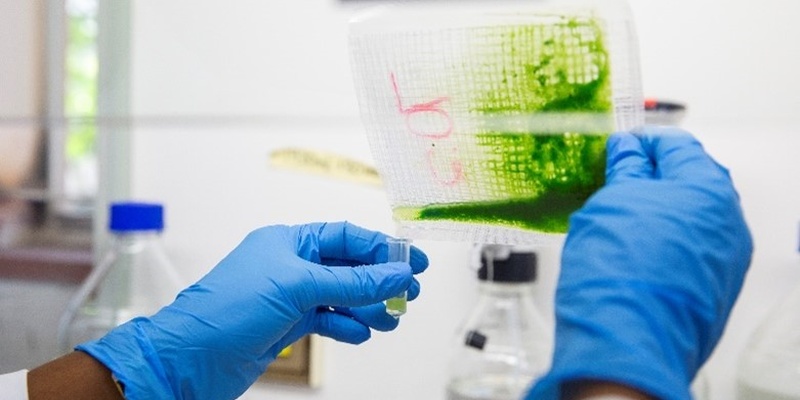
©FAO/Madelene Cronje
Vienna, 24 April 2026 — International experts in plant protection and diagnostics have emphasised the importance of rapid and accurate diagnostics in strengthening surveillance systems, enabling early detection, for faster, more effective response measures.
At the high-level European and Mediterranean Plant Protection Organization (EPPO) Conference on Diagnostics of Plant Pests, from 22-24 April 2026 at the Austrian Agency for Health and Food Safety (AGES) in Vienna, Austria, participants reiterated the critical role of diagnostic protocols in promoting early pest detection, strengthening international cooperation and building mutual trust through transparency and shared technical standards.
Without harmonized and reliable protocols, laboratories would apply inconsistent criteria, increasing the risk of pest misidentification, delayed response to outbreaks, and the spread of plant pests across borders.
The conference thus provided a good platform for information and experiences exchange. With over 140 participants, discussions focused on innovations in laboratory technologies; test development and validation; how diagnostics support pest risk analysis and regulation; emerging pests and cross-border initiatives for improving plant health cooperation.
Harmonizing plant pest diagnostics
Adriana G. Moreira, Programme Officer and Officer-in-Charge of the Integration and Support Team and Marina Martino, Phytosanitary Standard Setting Specialist, represented the International Plant Protection Convention (IPPC) Secretariat. In her keynote presentation titled: Beyond standards: The IPPC’s approach to strengthening global diagnostic cooperation, Moreira highlighted the importance of harmonized and well-developed pest diagnostics in global plant health. She pointed out the IPPC’s contribution to internationally applicable pest diagnostics and alignment into one operational system.
Adopted in 2006, International Standard for Phytosanitary Measures (ISPM 27) has served as the cornerstone of IPPC work on plant pest diagnostics. Its expanding set of annexes—pest-specific diagnostic protocols—provides national plant protection organizations (NPPOs) with clear guidance on the minimum requirements for accurate pest identification.
Moreira noted that in an increasingly interconnected world, standards alone are inadequate to bridge the global capacity gap.
“Through ISPM 27 and an integrated approach encompassing coordinated research, laboratory diagnostic networking and capacity development activities, the IPPC aims to transform a fragmented landscape into a proactive and cohesive global diagnostic infrastructure,” she said.
“Our goal is to ensure these protocols are robust and implementable for countries at all capacity levels, ensuring that countries have a baseline for international cooperation and trust in plant health,” said Martino.
Consequently, in 2023, the IPPC’s main governing body, the Commission on Phytosanitary Measures (CPM), approved a CPM Focus Group on Diagnostic Laboratory Networking to design a global network of diagnostic laboratory services and protocols to reduce duplication and enhance accurate diagnosis. A call for discussion papers on relevant topics was made, and the deadline is 22 May 2026. In March 2026, CPM noted the adoption of two diagnostic protocols (DPs) as annexes to ISPM 27: DP 35 for Meloidogyne mali and DP 36 for Genus Pospiviroid adding up to the suite of IPPC DPs available to countries.
![]() | ![]() |
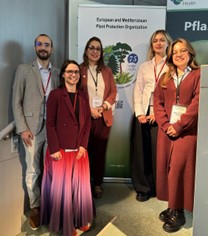
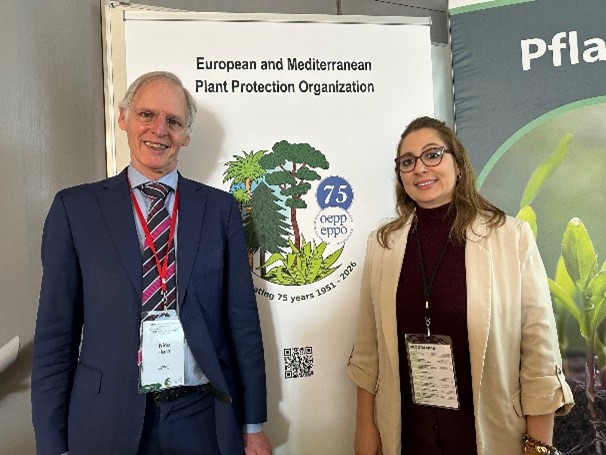
| ©FAO/ Marina Martino Adriana G. Moreira (center) and Marina Martino (right), with EPPO Secretariat staff | Nico Horn (left), EPPO Officer-in-Charge and Adriana G. Moreira (right), IPPC Programme Officer, during the conference |
Charlotte Trontin, EPPO Scientific Officer, noted that while new diagnostic methods are advancing rapidly, key challenges remain, including proper validation, availability of reference materials and proficiency testing schemes, ensuring that these tools are practical and for inspectors and technicians.
The EPPO Conference emphasized that maintaining and valuing expertise in classical diagnostic methods is essential as they remain the most accessible option for many users. Participants also stressed the importance of improving communication between laboratories and strengthening partnerships and networks, aligning with the IPPC’s global approach and work plan.
Other IPPC initiatives to strengthen global diagnostic cooperation
The IPPC Secretariat supports diagnostics also through its IPPC Plant Health Campus, providing technical guidance on surveillance, pest status determination, and prevention, preparedness, and response - such as diagnostics for Fusarium Tropical Race 4 (TR4) of banana. Furthermore, the IPPC Global Approach to Coordinated Phytosanitary Research, the IPPC Pest Outbreak Alert and Response System (POARS) and the Africa Phytosanitary Programme (APP) all contribute to a more connected, science-based and resilient global diagnostic system.
IPPC and EPPO: Partners for plant health
Within the IPPC framework, EPPO serves as Europe's regional plant protection organization, leading international efforts against the introduction and spread of pests; harmonized phytosanitary regulations; modern plant protection methods and plant health information services. The two organizations have also collaborated to develop diagnostic protocols, champion the International Day of Plant Health on 12 May and EPPO will host the maiden meeting of CPM Focus Group on Diagnostic Laboratory Networking June 2026. Founded in 1951 by 15 European countries, EPPO now includes 52 members across the European and Mediterranean region and celebrates its 75th anniversary in 2026.
Related information: