
CPM-20 Poster Exhibition Stories of successes and challenges: Innovation in implementing the IPPC instruments and tools
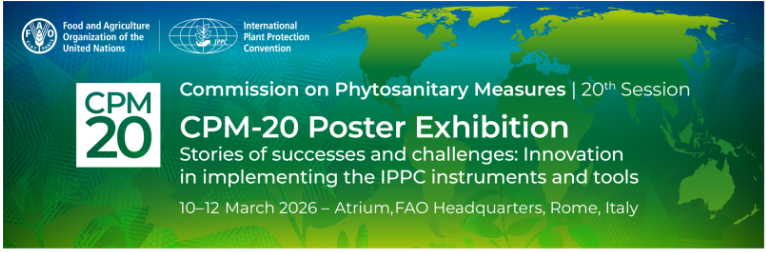
Date: 10 - 12 March 2026 | Venue: Atrium,FAO Headquarters, Rome, Italy
Despite the growing pressures of increased international travel and trade and climate shifting conditions, which accelerate the emergence and spread of plant pests and diseases, countries are increasingly strengthening their resilience and capacity to manage the global pest problem through effective implementation of phytosanitary measures and sustained capacity development. Adopted by 185 IPPC contracting parties, the IPPC tools and instruments harmonize phytosanitary measures and provide a framework for collective actions to prevent the international movement of plant pests.
The CPM?20 Poster Exhibition highlights the central role of implementation and capacity development in translating International Standards for Phytosanitary Measures (ISPMs) and other IPPC instruments and tools into practical, context?specific solutions.
The two-day exhibition will also feature a dedicated session with short presentations by selected poster authors, followed by discussion, to promote peer-to-peer learning, knowledge exchange and international collaboration.
Poster presentations
-
Australia: The Plant Biosecurity Research Initiative: A model for coordinated plant health research, development and extension in Australia
-
Australia (Department of Agriculture, Fisheries and Forestry): Optimizing container design to mitigate risks of pest contamination
-
Centre International de Hautes Etudes Agronomiques Méditerranéennes/ Mediterranean Agronomic Institute of Bari [CIHEAM Bari]): Multi-source IoT system prototype for the surveillance of Xylella fastidiosa
-
Committee Linking Entrepreneurship-Agriculture-Development (COLEAD): Phytosanitary hot water treatment for fruit fly control in West African mango exports
-
Ecuador (Agency for Phytoand Zoosanitary Regulation and Control [Agrocalidad]): Strengthening Foc TR4 and Moko management through farmer field schools in Ecuador
-
European Plant Protection Organization (EPPO): The EPPO database on resistance cases: addressing pesticide resistance to support plant health and One Health objectives
-
Italy (Centre International de Hautes Etudes Agronomiques Méditerranéennes/ Mediterranean Agronomic Institute of Bari [CIHEAM Bari]): RIGENESI: Science diplomacy & capacity building for Mediterranean plant health emergencies
-
Mali: From assessment to systemic reform: Mali’s experience with the IPPC Phytosanitary Capacity Evaluation (PCE) tool
-
Rentokil: SteamTainer®: A thermal phytosanitary alternative to chemical fumigation for wood logs and wood products
-
TMRW Eco: Beyond abandonment: Risk-reduced banana production on TR4-infested soils
-
Uganda (Ministry of Agriculture, Animal Industry and Fisheries): Systems approach for the management of pests of capsicums: Successes and challenges in Uganda.
-
Ugent University (Belgium: Integrating molecular tools into phytosanitary surveillance: Lessons from field implementation across trade pathways
Agenda for official opening on Tuesday, 10 March at 18:00hrs (CET)
|
NO |
Duration |
Description |
Presenter |
|
1 |
10 min |
Official opening of the session |
Enrico Perotti |
|
2 |
8 min |
General presentation - Introduction to the poster exhibition |
Rokhila Madaminova |
|
3 |
35 min |
Presentation of the four best posters: |
1. Halidou Mohomodou Agricultural Engineer, Director General, Plant Protection Office, Mali |
|
4 |
5 min |
Closing remarks |
Sarah Brunel |
The session will be moderated by Rokhila Madaminova, Programme Specialist, Implementation and Facilitation Unit,IPPC Secretariat
Click here for background information and agenda.