IPPC’s participation in the 30th Session of the FAO #COAG30
Posted on Mon, 27 Jul 2026, 08:58
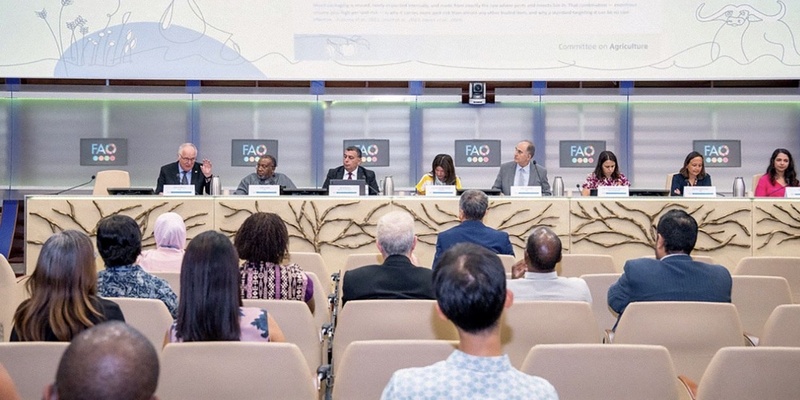
Side event at the 30th Session of the FAO Committee on Agriculture (COAG) discussed how plant health underpins the One Health approach. © FAO / Francisco Martinez
No One Health without plant health: The foundation of sustainable agriculture, public health and environmental protection
Rome, 27 July 2026. One Health begins with plant health. Delegates at a side event during the 30th Session of Food and Agriculture Organization of the United Nations (FAO)’s Committee on Agriculture (COAG) emphasized the importance of elevating plant health and One Health on global policy agendas, highlighting the growing evidence of the benefits of this approach in protecting food security, agriculture, public health and environmental sustainability.
During the session titled “Plant Health in One Health: Roles, challenges and prospects,” organized by FAO Plant Production and Plant Protection Division (NSP), participants discussed how protecting plant health contributes to safer food systems, biodiversity conservation, ecosystem services, soil health and resilience, and sustainable agricultural production.
Interconnected challenges like climate change, biodiversity loss, ecosystem degradation, transboundary plant pests and emerging diseases cannot be addressed by one sector alone. The One Health approach recognizes the connection between human, animal, plant, and environmental health and promotes collaboration across sectors to prevent and manage shared risks. However, plant health has often been underrepresented in One Health discussions, despite being a critical component of its objectives.
IPPC: A practical model for One Health
Prevention is the best investment. Plant pests and diseases threaten food security, agricultural production and ecosystems, causing up to 40 percent of annual crop losses worldwide and generating an estimated USD 220 billion in trade losses every year. The indirect impact extends far beyond the field.
“Prevention is better than cure, and plant health is one of the most practical forms of prevention we have. Science-based, internationally agreed standards can reduce risks at scale, turning prevention into measurable benefits for agriculture, trade, preparedness and One Health action,” said Enrico Perotti, Secretary of the IPPC.
By setting international plant health standards, facilitating information exchange and strengthening global phytosanitary capacity, the IPPC positions prevention as a core One Health action and demonstrates how its approach and tools serve as a practical model for implementing One Health across agriculture, ecosystems and safe trade.
Throughout the COAG session, the IPPC showcased how its approach functions as a global operating system, moving from international standards to coherent systems and from systems to national capability and measurable outcomes. The exhibition demonstrated how International Standard for Phytosanitary Measures No. 15 (ISPM 15) prevents the spread of plant pests through wood packaging materials, enabling safe trade and international movement of goods safe across all the One Health dimensions. It also featured the IPPC Plant Health Campus, offering free certified courses to more than 32 000 learners and 17 online courses.
Evidence and global action
FAO and the IPPC are leading efforts to establish and implement global standards, advance plant health policies, build capacities and invest in early warning systems. COAG delegates reiterated their commitment to continued joint action.
Ambassador Evelyn Ashton-Griffiths, Permanent Representative of the United Kingdom of Great Britain and Northern Ireland, emphasized the need to accelerate evidence uptake in decision making, noting that plant health remains underrecognized within One Health. She highlighted that evidence-based policymaking helps determine where future investments should be directed, supported by knowledge generation, evidence synthesis and learning platforms.
Ambassador Elif Çomoğlu Ülgen, Permanent Representative of Türkiye, reaffirmed the country’s commitment to One Health and referred to the upcoming World Bank Pandemic Fund project, which will establish a National One Health Committee and technical working groups to strengthen coordination across sectors.
Challenges, actions and future directions
Discussions highlighted key areas for strengthening plant health systems as part of One Health, including investment in national plant protection organizations, early warning systems, prevention and phytosanitary capacity; the development and consistent implementation of harmonized, risk‑based standards and innovations such as the IPPC ePhyto Solution; and promoting accountability across the supply chain.
In his closing remarks, Chikelu Mba, Deputy Director of FAO’s Plant Production and Protection Division, stressed the importance of coordinated investment and action to strengthen plant health systems, which are essential foundations for One Health implementation. “Under the NSP Impact portfolio, our planned actions focus on five programme‑priority areas, including strengthening surveillance, monitoring and early warning systems; mainstreaming integrated pest management; and reinforcing policies and regulatory frameworks. Over the next five years, we expect to mobilize and implement USD 100 million across 50 countries,” he said.
The event reaffirmed that plant health is where One Health becomes operational. The IPPC approach shows how plant health for one health can be translated into measurable action across the environment, agriculture and economy.