IPPC Pest Alert: First confirmed report of Clavibacter nebraskensis outside North America
Date of issue: 03 Mar 2025
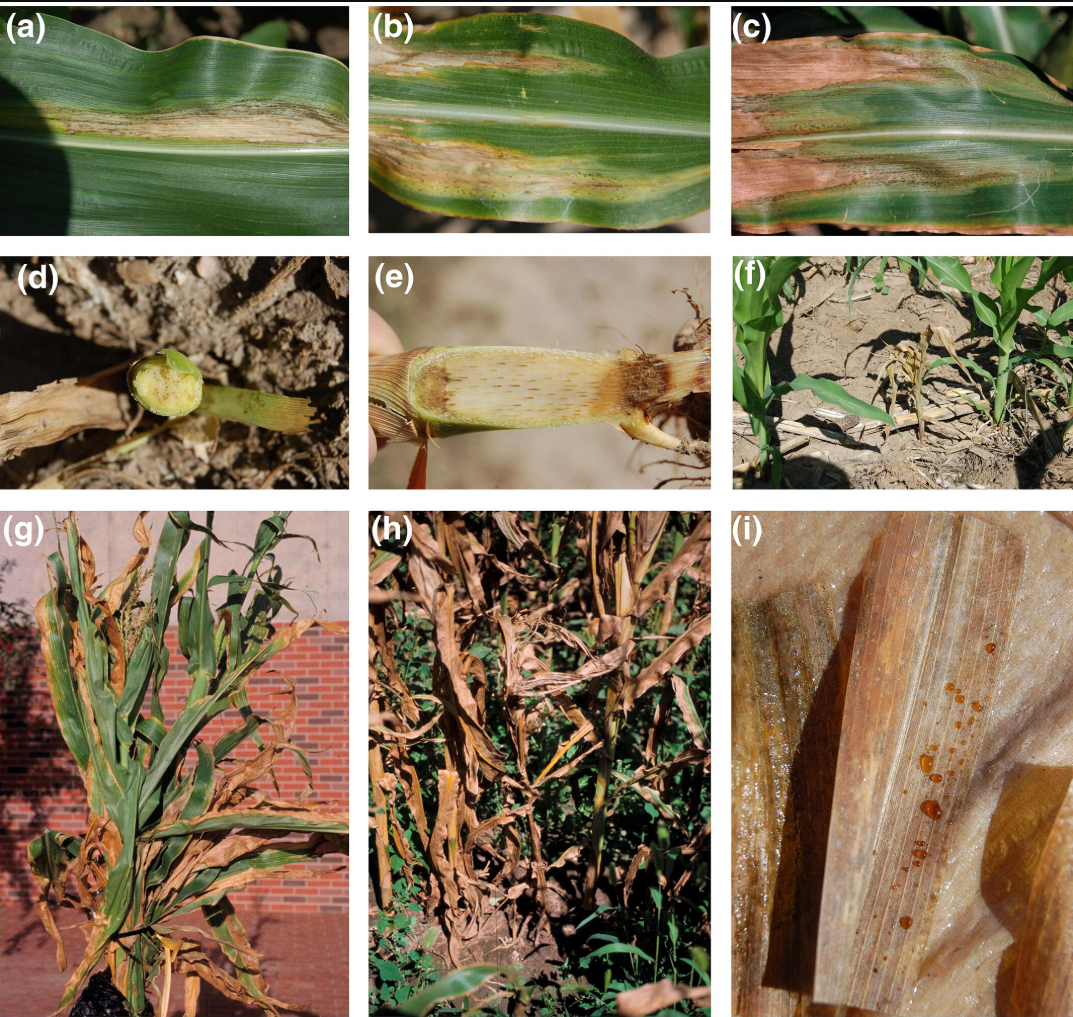
© Osdaghi, E., Robertson, A.E., Jackson-Ziems, T.A., Abachi, H., Li, X., & Harveson, R.M., 2022. Licensed under CC 4.0. Clavibacter nebraskensis causing Goss's wilt of maize, 2024
Reason for this alert
Distribution
Africa: South Africa.
North America: Canada, Mexico, United States of America (EPPO Global Database).
Hôtes
Maize (Eichenlaub, R., & Gartemann, 2011; Lang et al., 2017).
Impact
Severe infections have been documented to cause yield losses of up to 50% in susceptible maize varieties, especially under favorable environmental conditions such as high humidity and warm temperatures (Jackson-Ziems et al., 2014). Between 2012 and 2015, estimated total yield losses due to Goss’s Wilt in the U.S. and Canada exceeded 1.27 million tonnes, making it one of the most destructive maize diseases in the northern U.S. and Ontario (Wise et al., 2019).
Environmental conditions favoring spread:
The pathogen thrives in warm temperatures and high humidity, which are common in maize-growing regions (Wise et al., 2019).
Pathways
The pathogen spreads through both natural and human-mediated pathways. Naturally, the pathogen can spread via wind-driven rain, contaminated soil, and infected crop residues, which serve as reservoirs for future infections. Human activities, such as the movement of contaminated agricultural equipment and the trade of infected plant material, facilitate long-distance spread. Seeds spreading is possible. However, the spreading rates of seeds are considered low (Flores-Lopez et al., 2024). The risk of these pathways needs to be carefully determined.
Disclaimer
IPPC Pest Alerts are an early warning tool for emerging pests identified through routine POARS horizon scanning, which includes scientific and technical sources and specialized databases. The information contained herein is considered current as of the date of issue.
While produced by the IPPC Secretariat, these alerts are intended for informational purposes only and do not constitute an official declaration of pest status by the IPPC or FAO. In some cases, the sources of information might not have been confirmed with the corresponding National Plant Protection Organization (NPPO) at the time of publication. The IPPC Secretariat and the FAO assume no liability for the accuracy or completeness of this information, nor for any actions taken in reliance thereon. This alert should be used with these limitations in mind.
If you have any questions or comments about this alert, please e-mail us at [email protected]
References
1 Eichenlaub, R., & Gartemann, K. H. (2011). The Clavibacter michiganensis subspecies: Molecular investigation of gram-positive bacterial plant pathogens. Annual Review of Phytopathology, 49(1), 445-464.
2 EPPO Global Database. (2025). Clavibacter nebraskensis (CORBNE) – Distribution. European and Mediterranean Plant Protection Organization. Retrieved 02/28/2025, from https://gd.eppo.int/taxon/CORBNE/distribution
3 European and Mediterranean Plant Protection Organization (EPPO). (2025). Clavibacter nebraskensis – Alert list. Retrieved 02/28/2025, from https://www.eppo.int/ACTIVITIES/plant_quarantine/alert_list_bacteria/Clavibacter_nebraskensis
4 Flores-López, L. F., Olalde-Portugal, V., Vidaver, A. K., Morales-Galván, Ó., Hernández-Rosales, M., & Huerta, A. I. (2024). Unlocking a Mystery: Characterizing the First Appearance of Clavibacter nebraskensis in Mexican Cornfields. Plant Disease, 108(5), 1374–1381. https://doi.org/10.1094/PDIS-08-23-1493-RE
5 Jackson-Ziems, T. A., Harveson, R. M., & Vidaver, A. K. (2012). Goss's bacterial wilt and leaf blight of corn. Plant Health Progress, 13(1), 1-7. https://doi.org/10.1094/PHP-RS-12-0160
6 Wise, K. A., Smith, D. L., Freije, A. N., & Mueller, D. S. (2019). An overview of Goss’s bacterial wilt and blight. Crop Protection Network. https://cropprotectionnetwork.org/publications/an-overview-of-gosss-bacterial-wilt-and-blight
7 Lang, J. M., DuCharme, E., Ibarra Caballero, J., Luna, E., Hartman, T., Ortiz-Castro, M., ... & Jackson-Ziems, T. A. (2017). Detection and characterization of Clavibacter nebraskensis causing Goss's bacterial wilt and blight of corn in Mexico. Plant Disease, 101(5), 836-844.
8 Osdaghi, E., Robertson, A. E., Jackson-Ziems, T. A., Abachi, H., Li, X., & Harveson, R. M. (2022). Clavibacter nebraskensis causing Goss's wilt of maize: Five decades of detaining the enemy in the New World. Molecular Plant Pathology. https://doi.org/10.1111/mpp.13268
Bulletin d'information de la CIPV
Abonnez-vous pour recevoir les dernières nouvelles from the IPPC in your inbox.
Subscribe