

Global plant health leaders convene for CPM‑20 to strengthen international standards, innovation and cooperation
Posted on lun, 09 Mar 2026, 14:11
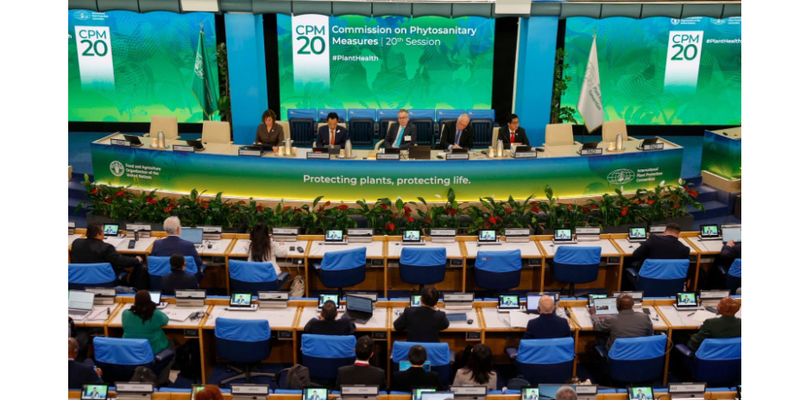
© FAO/ Giuseppe Carotenuto
Rome, Italy, 9 March 2026 – The Twentieth Session of the Commission on Phytosanitary Measures (CPM‑20), the governing body of the International Plant Protection Convention (IPPC), officially opened today, bringing together the plant health community to assess global efforts and strengthen international cooperation.
The week-long meeting, being held at the headquarters of the Food and Agriculture Organization of the United Nations (FAO) in Rome, and online, marks the Commission’s 20th year. CPM sessions are held annually as a principal forum for decision‑making on measures that protect plants and plant products. Plant health forms the backbone of food security, keeping agrifood systems sustainable by preventing the entry and spread of plant pests.
FAO Director‑General Qu Dongyu opened the session, followed by FAO Deputy Director-General Beth Bechdol, with keynote speeches via video message from Baroness Hayman of Ullock, Minister for Biosecurity, Borders and Animals of the United Kingdom, and H.E. Junimart Girsang, Ambassador and Permanent Representative of Indonesia to FAO.
IPPC contracting parties, national and regional plant protection organizations, international organizations and observers will engage actively across a wide range of topics that impact plant health. CPM‑20 is conducted in FAO’s six official languages and livestreamed to ensure broad global access (follow the webcast here).
Key decisions and standards
As increased trade, and evolving pathways continue to heighten plant health risks, CPM‑20 underscores the critical role of international standards in the trade of plants and plant products, as well as building country capacity to effectively implement these standards.
Contracting parties are anticipated to deliberate and adopt International Standards for Phytosanitary Measures (ISPMs), including draft revisions and annexes addressing:
- The establishment and maintenance of pest free areas for fruit flies (Tephritidae);
- Field inspection guidelines; and
- New phytosanitary treatments, including irradiation treatments for regulated pests.
Delegates will review progress on implementing the IPPC Strategic Framework 2020–2030, including updates on key development areas including expanding electronic phytosanitary certification through the IPPC ePhyto Solution; advancing commodity and pathwayspecific standards; improving the management of ecommerce and courier pathways; strengthening pest outbreak alert and response systems; enhancing global research coordination; developing guidance for the use of thirdparty entities in phytosanitary actions; assessing climatechange impacts on plant health; and building stronger diagnostic laboratory networks.
IPPC subsidiary bodies and focus groups will provide updates on their respective work areas, while participants will review the progress on capacity development, the Africa Phytosanitary Programme and other initiatives aimed at strengthening national plant protection systems.
Innovation, science and emerging risks
With a strong emphasis on innovation and science in plant health, CPM-20 will feature a dedicated Science Session to highlight the role of phytosanitary systems in the safe provision of food and humanitarian aid, highlighting the importance of plant health in emergency and crisis contexts, as food and other humanitarian aid can carry plant pests and can impact livelihoods long after recovery from the emergency.
For the first time, the CPM will feature a Plant Health Innovation Fair at the FAO, showcasing digital tools, artificial intelligence applications, surveillance technologies and practical innovations supporting pest prevention, early detection and response. Three poster sessions will further highlight innovation, international cooperation and practical experiences in implementing IPPC instruments.
Speaking at the CPM-20 opening, Qu Dongyu notes, “Healthy plants and crops are central to FAO’s vision of more sustainable, resilient and inclusive agrifood systems. IPPC contracting parties are on the front line of global plant protection. Your work safeguards farms and forests worldwide. The decisions you will make have a real impact in crop fields. I am confident that the CPM will continue to strengthen global plant health protection.”
IPPC Secretary Enrico Perotti, emphasized, “CPM sessions like today are even more instrumental in protecting plants – healthy plants and stable food supplies are a lifeline to many. We are entrusted to deliver systems and tools that effectively prevent pests from entering borders, destroying precious biodiversity and disrupting international trade. Let us, therefore, use this Twentieth Session to reaffirm our shared commitment to the IPPC’s mission: to protect global plant resources from pests and ensure safe trade for a food secure world.”
For more information, including the agenda, visit the CPM-20 page of the IPPC here.
About IPPC
The IPPC is an international treaty ratified by 185 contracting parties- 184 countries and the European Union, aiming to protect the world's plant resources from the introduction and spread of pests, while promoting safe trade. International Standards for Phytosanitary Measures (ISPMs), developed under the auspices of the IPPC, assist countries in implementing national phytosanitary standards and import requirements. The IPPC, deposited at FAO, is the sole global standard-setting entity for plant health.
About FAO
The Food and Agriculture Organization (FAO) is a specialized agency of the United Nations that leads international efforts to defeat hunger. FAO’s objective is to achieve food security for all and make sure that people have regular access to enough high-quality food to lead active, healthy lives. FAO works to transform agri-food systems by promoting sustainable production and consumption, including protecting the world’s plants, to achieve global food security. FAO works in over 130 countries worldwide and has 195 members - 194 countries and the European Union.
For media enquiries please contact:
Mutya Frio
Strategic Communications Specialist
+393334667086
IPPC Secretariat
Email: [email protected]
Anita Tibasaaga
Writer and Communication Specialist
IPPC Secretariat
Email: [email protected]
Subscribe
Subscribe to the IPPC Newsletter
Bulletin d'information de la CIPV
Abonnez-vous pour recevoir les dernières nouvelles from the IPPC in your inbox.
Subscribe