SPOTLIGHT: From vulnerability to food resilience: Improved pest surveillance to catalyse Sierra Leone’s agricultural improvement
Posted on mer, 17 Déc 2025, 08:57
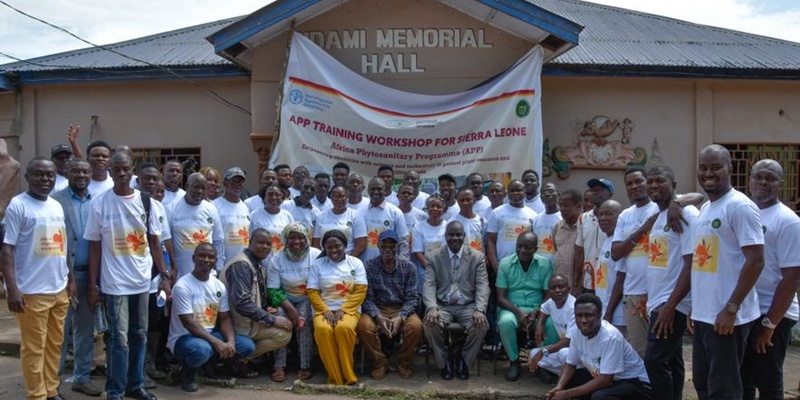
Participants, trainers and officials from FAO Sierra Leone, Ministry of Agriculture, the NPPO and IPPC Secretariat, at the workshop in Bo, Sierra Leone © FAO/ Anita Tibasaaga
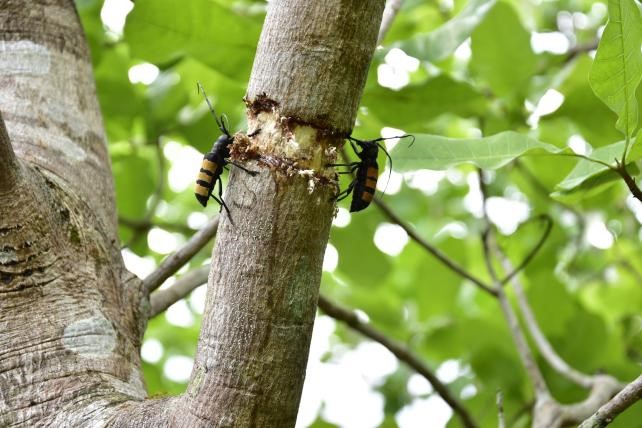
On a scorching afternoon, in Sumbuya village, Kakua chiefdom, Bo District, three farm workers—Mamie Squire, Mohamed Yambasu and Morie Lavai stand in a sprawling 1000-acre cashew farm as 40 phytosanitary specialists, crop and crop protection officers from Sierra Leone’s Ministry of Agriculture and Food Security, Njala University and Sierra Leone Agricultural Research Institute demonstrate the use of digital and geospatial surveillance of pests such as a the Stem girdler, Diastocera trifasciata- a threat to economically important crops such as cashew.
The flat-faced longhorn beetle gnaws through tree stems, cutting off water and nutrient flow and causing the branches to fall off. For Sierra Leone, pests such as the Stem girdler are a national threat, jeopardising food security, livelihoods of hundreds of farmers and undermining Sierra Leone’s potential as a major cashew processor and exporter. According to Sierra Leone’s Annual Agricultural Survey Report, 2024, crop pest and disease outbreaks are the biggest shocks affecting farmers, causing about 65 percent crop losses. The stakes could be higher if the threat is not adequately addressed.
Stopping trouble in its tracks
Determined to move from vulnerability to resilience and sustainability, Sierra Leone, through the Crop Protection Unit of the Ministry of Agriculture and Food Security, is embracing agricultural innovation through the Africa Phytosanitary Programme (APP), an initiative of the International Plant Protection Convention (IPPC). By deploying advanced digital and geospatial surveillance tools, the country is shifting from reactive pest control— which in the past has led to huge financial costs —to proactive prevention, timely data collection and rapid response to pest outbreaks. A ray of hope for farm workers like Squire, Yambasu and Lavai.
“We want to ensure that we can feed ourselves. We want to prevent hunger and malnutrition. Data collection on pest presence is very meaningful to achieve our goal”, said Honourable Henry Sahr Hemore, Deputy Minister II of Agriculture and Food Security. He noted that using reliable data is essential for agricultural transformation through national programmes like the Feed Salone.
He was speaking at a training workshop where 40 phytosanitary specialists, crop officers and crop protection officers learned to use APP's suite of cutting-edge digital pest surveillance tools. The workshop was organized by the Crop Protection Unit— the national plant protection organization (NPPO) and the IPPC Secretariat, supported by the Food and Agriculture Organization of the United Nations (FAO).
From pest identification, diagnostics, pest trapping and real-time data entry via the APP GIS Hub, a web-based portal for storing and retrieving field data, participants gained hands-on experience in modern surveillance techniques. They also received state-of-the-art tablets, equipping them to conduct more precise monitoring and promptly mitigate pest threats across all 16 agricultural districts.
The training was delivered by plant health experts and researchers trained at the first APP Train-the-Trainer workshop in 2023, an approach aimed to create a network of phytosanitary officers capable of supporting the entire continent.
In a message delivered on his behalf, Enrico Perotti, IPPC Secretary, urged the national leadership and stakeholders to embrace the APP, invest in national capacity development and allocate resources to strengthen surveillance. “These actions are critical to unlocking better trade opportunities, ensuring food security and safeguarding environmental sustainability.”
Towards phytosanitary compliance, food security and better trade
Through APP, Sierra Leone is prioritizing the monitoring of five high-impact pests: Bactrocera zonata (fruit flies), cassava mosaic virus, Stem girdler, Fusarium oxysporum f.sp. cubense, and Cocoa Mirid. However, using APP’s versatile geospatial tools, inspectors can also monitor and track other pest threats such as Fall Armyworm and pepper mottle virus. Building pest surveillance and data collection capacity will:
-
Enhance compliance with international standards for phytosanitary measures (ISPMs) e.g. ISPM 6 on Surveillance
-
Reduce emergency pest response costs through early warning action
-
Boost international market access and trade confidence, with verifiable pest-free production data
-
Increased crop yields and reduce the import bill
Voices from the field
“We are taking APP and this training seriously. After the training, the inspectors will ensure implementation and regular data collection and analysis”- Alie Mansaray, Head of NPPO of Sierra Leone.
“Previously, the process of monitoring and identifying pests was done through more strenuous methods. But now, using digital tools will enable easier pest surveillance. When the Fall Armyworm broke out, it caused a lot of havoc and maize production that year was not possible”- Edmond Saidu, Acting Director of Crops.
“The IPPC is strengthening Sierra Leone’s limited phytosanitary capacity. APP will help to fill surveillance data gaps. Better surveillance will improve early pest identification. The sooner these are identified, the easier it will be to mitigate them”- Alusaine Edward Samura, Head of Department, Crop Protection, Njala University and APP trainer.
“We used to harvest over 100 bags of cashew, but the Stem girdler has slashed yields. If it persists, we could lose our jobs. We hope that better pest surveillance will address the problem”- Mamie Squire, farmer.
“We grow a lot of cassava and vegetables but exporting them is a challenge because of pests. With better surveillance and using the tools from this training, we will be able to detect and prevent pests in a more efficient way to ensure export of quality produce”- Kadijatu Alice Koroma, District Crops Officer, Bo.
By harnessing science and technology for national capacity in plant pest prevention, Sierra Leone is not only technically upgrading but demonstrating a transition from vulnerability to resilience. As the deputy minister II Hemore said, “we must reach that point where hunger is eradicated in Sierra Leone.”
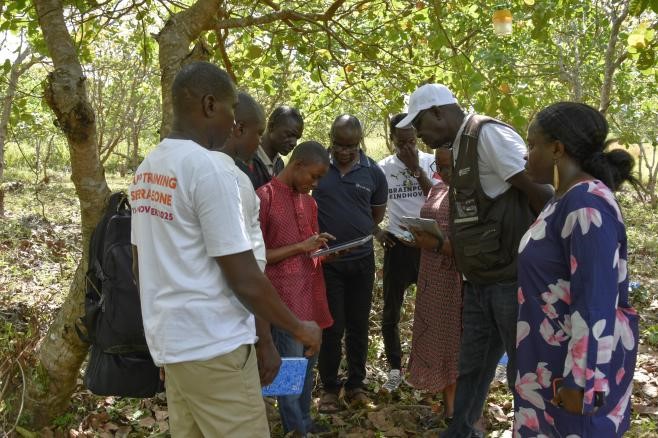 |  |
| Arop Deng (in white hat)- APP Consultant, IPPC Secretariat and Raymonda Johnson (right), Crop Protectionist and Sierra Leone APP trainer, guide participants during the field demonstration. © FAO/ Anita Tibasaaga | Arop Deng (in white hat)- APP Consultant, IPPC Secretariat and Raymonda Johnson (right), Crop Protectionist and Sierra Leone APP trainer, guide participants during the field demonstration. © FAO/ Anita Tibasaaga |
Subscribe
Subscribe to the IPPC Newsletter
Bulletin d'information de la CIPV
Abonnez-vous pour recevoir les dernières nouvelles from the IPPC in your inbox.
Subscribe